Cleaning and Care for Counter Seating
What to wipe, what to blot, and the one chip near the floor that decides whether a metal frame lasts five years or fifteen.
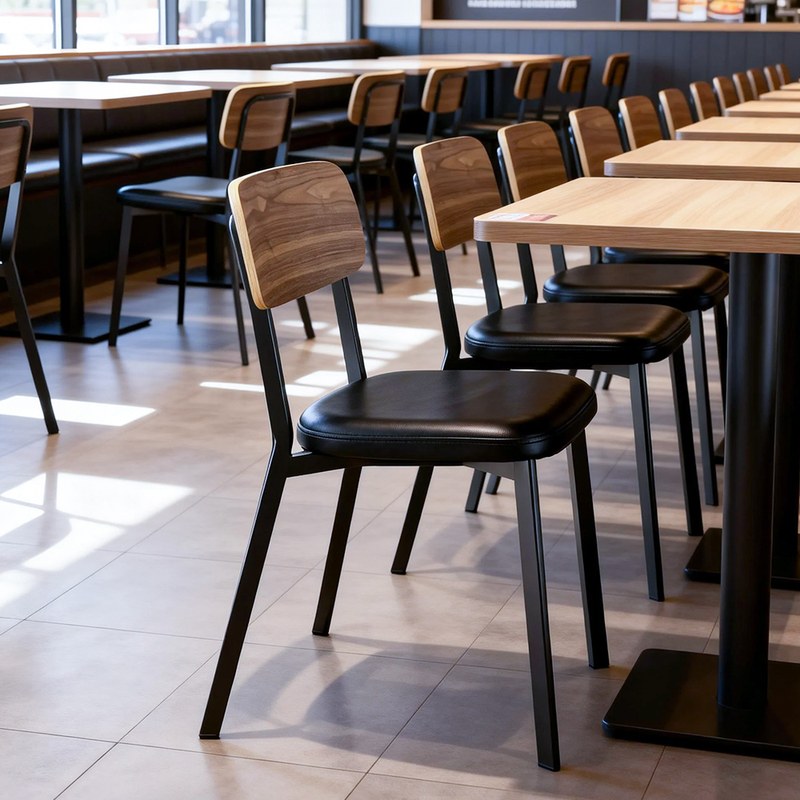
Daily wipe-down, in the order that works
Tables first, then seat surfaces, then frames. Wiping the frame first pushes crumbs onto the seat you just cleaned. Neutral detergent at the label dilution is enough for both.
Never wipe wood with a soaking cloth. Damp-wipe and dry within a minute; standing water is what lifts a finish.
Stains on upholstery: act inside the hour
Blot, do not rub. Coffee and milk lift with cool water and a drop of detergent; oil needs a solvent cleaner and a test on the underside first. Stains treated within an hour usually leave nothing.
Wood and oil finishes age differently
Lacquer resists spills and cannot be repaired locally: one deep scratch means a respray. Oiled tops take a scratch and take a re-oil, but need re-oiling twice a year.
For a busy room, lacquer and accept the respray. For a room with a workshop nearby, oil and keep the tin in the back.
Metal, rust and the one place it starts
Rust starts at a chip, almost always near the floor. Touch up a chip the week you see it and the frame lasts; leave it and the coating lifts in a ring around the damage.
Stainless tops and frames are not rust-proof. Salt and bleach both attack them. Rinse after cleaning and dry the surface.
Moving furniture without breaking it
Lift and carry, never drag, on a timber floor. On tile, a chair with worn glides will scratch the glaze in a week, and the scratch holds dirt that no mop reaches.
Replace glides once a year on the chairs that get moved most. Glides cost less than one table top.
Spares and the parts list
Keep a parts list with the original order: glide type, screw size, upholstery code, finish name. Reordering from that list two years later is a five-minute email; reordering from a photo is a month.
cafe furniture catalogue ship with a parts sheet that maps to the model number, so the list stays valid when the cafe adds a second site.
What the purchase order has to say
Furniture orders that go wrong usually went wrong on paper. The line that causes the argument is rarely the price — it is the finish, the size tolerance or the packing.
Write these onto the order: model number, finish name and code, upholstery code, counter seat overall size with a tolerance of plus or minus 5 mm, carton count, and the spare parts list. Anything not written is a guess at the other end.
Three things to check the day it lands
Open one carton per model before signing the delivery note. Check the frame for a bend at the leg, the top for a chip on the edge, and the seat for a colour difference against the sample you approved.
Photograph anything you accept with a note. Defects recorded on the delivery day are warranty claims; the same defect reported three weeks later is a discussion.
How the quote is actually built
Frame, upholstery, finish, packing and freight. Those five lines cover almost all of it, and the only one that varies with quantity is frame and upholstery.
Ask for the unit price at 20, 50 and 100 pieces. Quotes that do not move between those steps are either already at the floor or padded at the top.
Ordering the same thing again in two years
Dye lots change. The frame you reorder in year three will match the drawing and may not match the seat next to it, which is why the spec sheet matters more than the photo.
Keep the finish code and the upholstery code on file. all cafe furniture models reorders from that code without a new sample round, which saves three weeks.
Where to go next
The full range sits in one place: cafe sets, custom cafe furniture, and the cafe layout support desk for anything off-plan.
How do I clean a stained seat?
Can a scratched lacquer top be repaired?
Where does rust start?
Next in the same range
Storing Counter Seating Between Services
Storing counter seating: stack height against ceiling height, where the stack belongs, and the three points wh
Read more →How Many Cafe Chairs Fit a Room, and Where They Go
Seat counts for cafe chairs from the usable floor: a 40 sqm room holds 20 to 26 covers at 2.2 sqm per two-top,
Read more →Seat and Table Heights for Cafe Chairs: What Fits
Heights for cafe chairs that work together: a 450 mm seat under a 720–750 mm top, 420–460 mm of seat width, an
Read more →Send a floor plan, get a seat count and a price
Tell us the room size, the counter length and how many covers you need. We come back with a layout, a seat count and a written quotation — usually inside three working days.