Booth runs, cut to the drawing
Booth seating is the only piece in a cafe that cannot be moved once it is in. It is also the cheapest seat per cover and the one guests ask for, so the depth and the back height are worth getting right the first time.
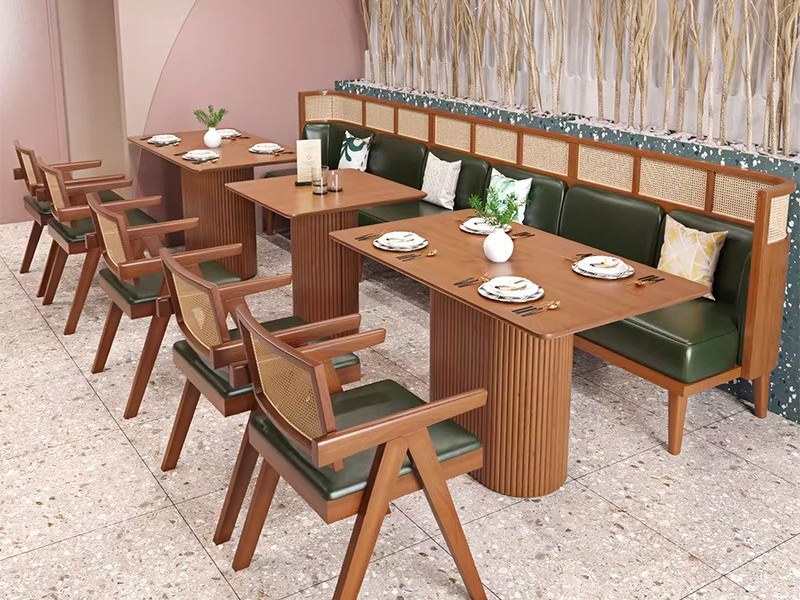
Booth runs in current production
Depth is the number that decides comfort
Seat depth on a booth is 500 to 550 mm. Below 480 mm the guest perches on the front edge; above 580 mm they cannot reach the back without sliding forward, and the back stops doing anything. The 500 mm version suits a cafe where people sit for forty-five minutes with a laptop; 550 mm suits the corner where people settle for two hours.
Back height matters almost as much. Backs at 900 mm support the shoulder blades; at 1050 mm they support the head and turn the booth into a room. Both are the same construction, quoted at the same price, and the taller one is what makes a cafe feel quieter than it is.
| Seat depth | 500 mm or 550 mm standard |
|---|---|
| Seat height | 450 mm, to match a 720–750 mm table |
| Back height | 900 mm low · 1050 mm high · 1200 mm screen |
| Length | Made to the drawing, in millimetres, no module limit |
| Corners | Inside and outside corners resolved in the workshop, not on site |
| Frame | Plywood carcass, solid timber edging, steel where the run is long |
| Base | Fixed plinth, or a plinth with a removable toe-kick panel for cleaning |
| Upholstery | PU, contract vinyl, wool, bouclé, or COM |
| Minimum order | One run, from about 1.2 m |
| Production | 20–35 days after drawing approval |
Why a booth is measured in metres and not in seats
Each booth seat takes 550 to 600 mm of run. Two people need 1.2 m, four need 2.4 m, and the table between them decides how the run is split. Quoting by the metre rather than by the seat is what lets a run finish exactly at the wall instead of 80 mm short with a filler panel nobody planned for.
Send the wall length and where the door swings, and the run is drawn to the millimetre. Where the wall is not straight — common in older buildings — a scribe strip at the back takes up the difference on site instead of a gap you can see.
Fixed or loose base
- Fixed plinth — the run is screwed to the wall and does not move. Cheapest, most rigid, and the floor under it never gets cleaned properly.
- Plinth with a removable toe-kick — the panel in front of the plinth lifts out, so a brush reaches underneath. Costs a little more, and it is the difference between a cafe that passes a hygiene inspection easily and one that does not.
- Loose base on glides — the run can be pulled out for a deep clean, or reconfigured when the layout changes. Only worth it on shorter runs; a 4 m loose run is hard to move and easy to knock out of line.
What a booth needs from the room
Booths work on a wall with 1.6 m of clear floor in front of them: 550 mm of seat, 600 mm of table, and 450 mm for a guest to get out. Below 1.5 m the person on the inside cannot leave without the outside guest standing up, which is fine for a coffee and not fine for a working morning.
Can a booth run follow a curved wall?
Do we need to fix it to the wall?
Can the upholstery be replaced later without rebuilding?
Send the wall length
Wall length, the door swing and the table positions. We return a drawn run to the millimetre, with seat count and price, usually in three working days.